


 ITA
ITA
 FRA
FRA
 ESP
ESP
 DEU
DEU
 CH
CH
 POL
POL
 NED
NED
 LIT
LIT
 HUN
HUN
 CZE
CZE
 SWE
SWE
 TUR
TUR
Sectors of use
Application sectors
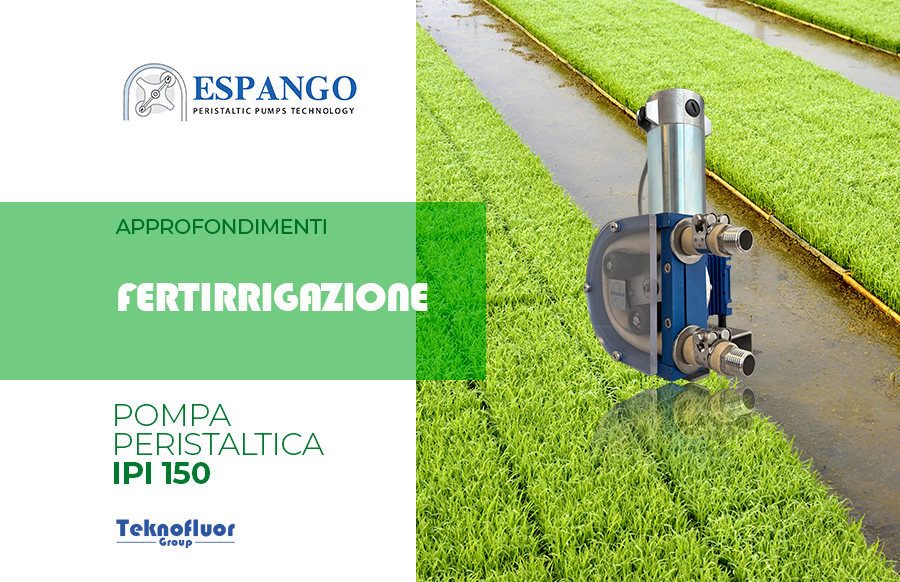
Fertigation is a technique increasingly used in agriculture to deliver fertilisers, nutrients and pH adjusters directly via the irrigation system. To dose nutrients without wastage, a reliable dosing system is required, capable of performing effectively even in challenging conditions.
Among the technologies available on the market, peristaltic pumps are one of the most sensible and tried-and-tested choices for managing the dosing of liquid fertilisers and all other substances used in irrigation systems. Choosing the right pump ensures that fertilisers are distributed evenly, preventing blockages or sudden machine stoppages.
Espango’s IPI 150 peristaltic pump is also suitable for this application. Indeed, it is a robust pump, built with high-quality components Made in Italy and designed to guarantee precision even in the most demanding open-field installations.
A peristaltic pump is a positive-displacement pump that transfers liquid by cyclically compressing a flexible tube using rollers. During operation, the fluid comes into contact only with the tube, without passing through the pump’s mechanical components.
This design principle makes peristaltic technology particularly suitable for industrial and agricultural dosing applications.

In fertigation systems, it is essential to distribute fertilisers, nutrients and other products in a uniform and controlled manner, avoiding overdosing, wastage and process interruptions.
For this reason, the peristaltic pump is one of the most widely used technologies for dosing liquid agricultural substances. Unlike other types of pumps, the fluid comes into contact only with the tube, without passing through any internal mechanical parts. This reduces the risk of product contamination and allows for the rapid replacement of the sole component subject to wear.
Furthermore, peristaltic technology is particularly well-suited to the dosing of liquid fertilisers, pH adjusters, biostimulants and other additives used in irrigation systems, thanks to its ability to maintain a constant flow rate even during prolonged operating cycles.
The main advantages of a peristaltic pump are:
- high dosing accuracy;
- uniform and constant distribution of liquid fertilisers;
- the liquid comes into contact only with the tube;
- reduced risk of fluid contamination;
- quick and easy maintenance;
- quick tube replacement;
- reliability even during continuous operation;
- the ability to dose fluids of different viscosities, depending on the tube material used.
These features make the peristaltic pump an ideal solution for fertigation systems, automatic irrigation systems, agricultural machinery manufacturers and OEM systems.

The IPI 150 is a medium-sized industrial peristaltic pump designed for integration into systems used in the agricultural sector. The pump’s design, featuring an exposed motor, can be configured in either a vertical or horizontal motor orientation, depending on the space available to the customer.
For agricultural applications, it can be equipped with a special low-voltage motor, a feature that facilitates its use in such systems. The pump is equipped with stainless steel threaded fittings, selected to ensure reliability and corrosion resistance in systems installed in agricultural environments.
Together, these features make the IPI 150 an ideal solution for machine builders, system integrators, and professionals seeking a dosing system for fertigation applications.
The IPI 150 peristaltic pump is used for dosing:
- liquid fertilisers;
- nutrients and trace elements;
- pH adjusters;
- irrigation additives;
- products for wastewater treatment.
Our IPI 150, like all standard Espango peristaltic pumps, uses Teknoprene® TPV tubing, a vulcanised thermoplastic rubber developed specifically for peristaltic applications.
The material’s characteristics ensure:
- mechanical and chemical resistance: it retains its properties intact after hours of continuous operation, even when pumping aggressive liquids;
- temperature resistance: it maintains its characteristics across a wide temperature range from -40°C to +120°C;
- operational durability and performance: the tubing does not stick together, even after a prolonged period of downtime.

One of the main strengths of peristaltic technology is that the pumped liquid flows exclusively through the tube.
This means that:
- the mechanical components remain completely isolated;
- the risk of contamination is reduced;
- maintenance is simpler;
This represents a significant advantage when dosing liquid fertilisers and additives
Yes. Peristaltic technology is particularly well-suited to dosing liquid fertilisers thanks to its flow accuracy and the fact that the liquid comes into contact only with the tube.
Peristaltic pumps reduce the risk of product contamination, simplify maintenance and ensure precise and repeatable dosing even during continuous operation.
Download our catalogue or contact us directly to gain a broader understanding of what Espango can design in partnership with you to meet your requirements in the field of industrial dosing.

